
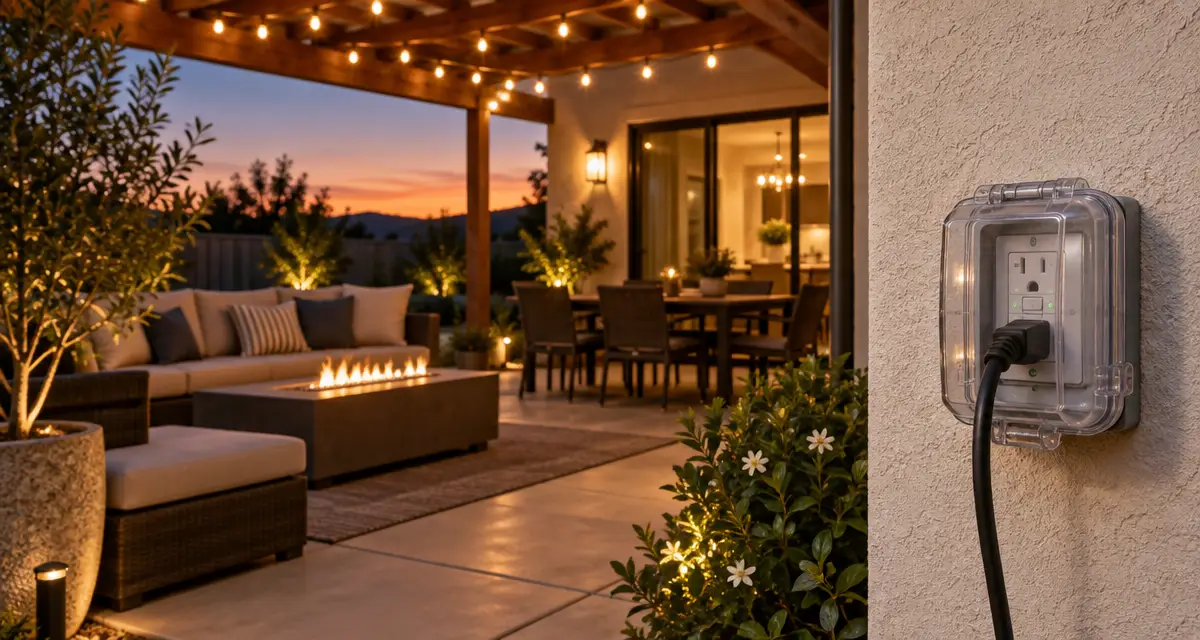
Installing patio outdoor outlets in Folsom, CA requires ground-fault circuit interrupter (GFCI) protection, weather-resistant receptacles, and weatherproof enclosures rated for outdoor exposure. Because patio string lights and landscape transformers stay plugged in for long periods, you also need an "in-use" bubble cover that keeps rain and sprinkler spray out even while a cord is attached. Following California electrical rules and pulling the required city permit ensures your backyard lighting setup stays safe year-round.
Whether you live in Empire Ranch, Broadstone, or near Historic Folsom, warm evening weather makes the backyard an extension of your living room. Relying on indoor outlets and running extension cords through sliding doors creates tripping hazards and damages door seals. Adding dedicated exterior receptacles is the safest way to power bistro lights, outdoor kitchens, and patio heaters.
Why Dedicated Patio Outdoor Outlets in Folsom, CA Beat Extension Cords
Many homeowners start their backyard lighting projects by plugging string lights into a garage outlet or running a heavy cord across the concrete. While this works for a single afternoon party, extension cords are strictly designed for temporary use. Leaving them exposed to Folsom's intense summer sun and winter rain quickly degrades the outer insulation.
Permanent indoor and outdoor outlet installation solves these problems by putting safe, grounded power right where you need it. You can mount receptacles under patio eaves for high-hanging bistro lights, along exterior stucco walls for cooking appliances, or on freestanding posts near garden beds. Having permanent outlets also allows you to plug in smart outdoor timers so your lighting turns on automatically at dusk.
Essential Protection Required for Exterior Receptacles
Outdoor electricity faces constant threats from moisture, dust, sprinklers, and fluctuating temperatures. To prevent electrical shocks and nuisance tripping, three layers of protection are required for modern exterior outlets.
GFCI Protection Against Shock Hazards
Water and electricity are a dangerous combination on damp patio slabs and wet grass. According to the CPSC Home Electrical Safety Checklist, all outdoor receptacles should have ground-fault circuit interrupter (GFCI) protection and weatherproof covers to guard against moisture and electrocution. A GFCI monitors the flow of current and shuts off power in a fraction of a second if it detects a leak, such as electricity passing through water.
You can achieve this protection either by installing a GFCI receptacle directly at the patio location or by installing a GFCI circuit breaker inside your main electrical panel. Our Folsom electrical services team can inspect your existing exterior circuits to see if upstream GFCI protection is already present or if a new device is needed.
Weather-Resistant and Tamper-Resistant Receptacles
Standard indoor outlets are not built to survive outdoor humidity or UV rays. Exterior installations require weather-resistant (WR) receptacles, which are made with UV-stabilized plastic that will not crack in the sun and corrosion-resistant metal parts that resist rust.
In addition to being weather-resistant, residential outlets must be tamper-resistant (TR). These receptacles feature built-in spring-loaded shutters that block foreign objects, keeping children and pets safe around low-mounted patio walls.
Damp vs. Wet Locations and In-Use Covers
Not all outdoor spots face the same level of weather exposure, and state standards draw a clear line between damp and wet areas. Under California's electrical regulations for wet and damp locations, enclosures and receptacles must be specifically rated for the environment and whether a cord remains plugged in unconditionally.
- Damp locations: These are partially protected outdoor areas, such as under a deep covered patio roof or porch canopy, where water will not beat directly against the wall.
- Wet locations: These are uncovered exterior walls, pergola posts, or yard areas exposed directly to rain, garden hoses, and lawn sprinklers.
- In-use weatherproof covers: Because patio string lights and landscape lighting transformers stay plugged in unattended, a flat flip-lid cover is not enough. Once a plug is inserted into a flat cover, the lid stays open and exposes the live blades to moisture. An extra-duty in-use cover (often called a bubble cover) is deep enough to close completely and latch over the plug while the cord feeds through a small slot at the bottom.
Planning Your Patio Lighting Layout and Circuit Capacity
Before cutting into stucco or siding, it helps to map out everything you plan to run in your backyard. LED patio string lights draw very little amperage on their own, which means they can often share an existing general-purpose circuit if it is not already heavily loaded.
However, outdoor living spaces rarely stop at string lights. If you also plan to run electric pellet smokers, outdoor refrigerators, space heaters, or fountain pumps, tapping into an existing indoor wall outlet can easily overload the breaker. In those cases, adding a dedicated circuit installation directly from your panel prevents tripped breakers when you are hosting guests.
Here are a few practical steps to plan your outdoor power layout:
- Choose the right mounting height: Mount outlets near the roofline or soffit if you only want to plug in overhead string lights without seeing cords running up the wall. Mount them 15 to 18 inches above the patio floor for general appliance use.
- Check sprinkler spray patterns: Run your irrigation system for a few minutes to make sure no sprinkler heads spray directly onto the spot where your new outlet will go.
- Pair outlets with permanent lighting: If you want a cleaner look without visible cords, an electrician can combine new outlets with hardwired indoor and outdoor lighting controlled by an indoor wall switch.
Permitting and Electrical Inspections in Folsom, CA
Adding new wiring and exterior outlets is more than a simple fixture swap. When you extend a circuit or run new conduit along an exterior wall, local building codes require a permit and a final inspection to verify that the wiring method, grounding, and weatherproofing meet safety standards.
The City of Folsom provides an online Folsom ePermit Center where homeowners and contractors can apply for residential electrical permits, submit project details, and schedule required inspections. Working with a professional electrician makes this process straightforward, as your electrician will make sure the box depth, conduit seals, and GFCI devices pass inspection the first time.
Ready to Power Your Folsom Backyard?
Whether you want a single hidden soffit receptacle for market lights or a full set of weatherproof outlets for a new outdoor kitchen, Lux Dei Electric is here to help. We handle everything from circuit evaluation and clean stucco mounting to full GFCI testing. You can even claim 10% off your next project when you book with our team.
To schedule an estimate, reach out through our contact page or call us at (916) 879-2995. You can also see recent projects on our Facebook page and Instagram profile. If we have already helped upgrade your home, we would love to hear about your experience on our Google review page, through our customer feedback form, or via our customer value form.
Frequently Asked Questions
Can I leave patio string lights plugged into an outdoor outlet all year?
Yes, provided the outlet is equipped with GFCI protection, a weather-resistant receptacle, and an extra-duty "in-use" bubble cover that closes completely over the plug. You should also make sure the string lights themselves are UL-listed for permanent outdoor wet locations rather than seasonal indoor use.
What is the difference between a weatherproof cover and an in-use cover?
A standard weatherproof flip cover only keeps water out when the lid is shut and nothing is plugged into the receptacle. An in-use cover has a deep dome shape that latches shut over the electrical plug, protecting the outlet from rain and sprinklers while your patio lights remain plugged in.
Can an electrician add an outdoor outlet on a stucco wall without ruining the finish?
Yes, experienced electricians can either fish wiring through the interior wall cavity into a surface-mounted weatherproof box or run neatly painted conduit along the exterior. Both methods minimize stucco patching and create a watertight seal against the wall.
Why did my outdoor patio outlet stop working after a rainstorm?
If an outdoor outlet loses power after rain, the GFCI protection has likely tripped due to moisture entering the receptacle or a connected extension cord. Unplug your patio lights, let the area dry, and press the "Reset" button on the outdoor GFCI outlet or on the linked GFCI outlet located in your garage, bathroom, or main electrical panel.